Showing posts with label Books. Show all posts

Wednesday, March 30, 2011

Reading Material

My reading material for the next couple of weeks....


I guess I need to bury myself in reading. Wish me luck!

Thursday, November 19, 2009

The Bloomsbury Cafe- I'm in book club heaven!

Quite a while back, my friend Alicia and I were discussing how much we missed discussing literature. I think we both equally missed the intellectual stimulation of undergraduate education, and especially of our English major courses. Alicia was the first to come up with the idea of a book club. Fast forward a couple of months to the creation of our very own English major book club- The Bloomsbury Cafe. Right now the cafe consists of Alicia Johnson, Megan Welton, and Kristi Peters Millett.

To start the club off, Alicia sent us a series of questions, the answers of which you can find below. After that we got our first reading assignment- Toni Morrison's A Mercy. My response to the book will be coming soon. For now, enjoy the reading below!


1. Name: Krystal Nanette Downs (http://krystaldowns.blogspot.com/
2. Favorite place you have lived: Camarillo, California
3. Place you would like to live if you could: Can I pick more than one? Ireland. Southern California. Italy.
4. What do you do when you aren't reading? I WORK. Right now I have a full-time job and and what feels like a full-time internship. When I have the occasional spare moment, I enjoy swimming, riding my bike, going to bookstores (that doesn't count right?), dancing, listening to a wide array of music, laying in the sun, meeting new people, traveling, watching trashy T.V. shows, and going to the beach if I'm near one.
5. 3 favorite films: Right now they are: Fargo, The Hours, The Departed
6. 3 favorite foods: Sushi, fruit, Indian
7. Major, specialty in major if any: English. Minors: sociology and women's studies
8. Favorite literary time period: Post-modern lit/post 1950's.
9. 3 favorite books and why: 3 favorites! Well if I have to choose...

God of Small Things by A. Roy. I read this book a long time ago, and so cannot completely explain why I love this book so much. I always loved the fairy tale type storytelling that one find in Indian literature, so I know that is part of it. I remember this book touching me on so many different levels. It was one of those books that stays with you long after you read the last line. I love Roy's language that seems playful and tragic. So many simple phrases knocked me down with their power. She breaks all the rules of language in all the right ways. Her moral judgements on her characters are clear and brutal. And her judgements on her readers are unbending; not once was I allowed to break free from her words and the critique behind them.
Here is an excerpt: "Perhaps it's true that things can change in a day. That a few dozen hours can affect the outcome of whole lifetimes. And that when they do, those few dozen hours, like the salvaged remains of a burned house---the charred clock, the singed photograph, the scorched furniture---must be resurrected from the ruins and examined. Preserved. Accounted for. Little events, ordinary things, smashed and reconstituted. Imbued with new meaning. Suddenly they become the bleached bones of a story." AWESOME!

Anna Karenina by Tolstoy
I took a Russian Literature class while at BYU and loved it. It gave me an excuse to read so many brilliant books. I had read Anna Karenina on my own before, but fell in love with it the second time around. The characters are all so hopeless; I wanted to shake them all and say look at what you're doing, ruining your life, for what? In this case, most of the characters are ruined because of love or at least what looks like love. My favorite character by far is Levin who is always searching for something, be it truth or love, and never can seem to find it.
His thoughts and speeches are so remarkably poignant, that when I was reading the novel I wanted to underline everything. That is how quotable Anna Karenina is.

Lolita by Nabakov
I know Alicia is squirming right now. I really do love this book though. Yes, the characters and themes are a little disturbing. But I love his writing more than almost anyone else I've read. I feel like each of Nabakov's sentences are words of poetry. He makes pedophilia, incest, and the most vile and disgusting sound and look beautiful. You can really see that he is a true master of language.
Just listen to his genius first lines: Lolita, light of my life, fire of my loins. My sin, my soul. Lo-lee-ta: the tip of the tongue taking a trip of three steps down the palate to tap, at three, on the teeth. Lo. Lee. Ta. She was Lo, plain Lo, in the morning, standing four feet ten in one sock. She was Lola in slacks. She was Dolly at school. She was Dolores on the dotted line. But in my arms she was always Lolita. Did she have a precursor? She did, indeed she did. In point of fact, there might have been no Lolita at all had I not loved, one summer, an initial girl-child. In a princedom by the sea. Oh when? About as many years before Lolita was born as my age was that summer. You can always count on a murderer for a fancy prose style. Ladies and gentlemen of the jury, exhibit number one is what the seraphs, the misinformed, simple, noble-winged seraphs, envied. Look at this tangle of thorns.
Nabokov would always tell people that he thought in images and that letters and words for him were colored (literally). Not surprising considering language like the above, no?

10. How do you like to approach literature? Do you have a particular reading strategy you usually employ? My inclinations push me towards a feminist approach, although I do think that if one is a true critical reader, one must look at literature from many, if not all, modes of reading. I also have a deep love of Marxist criticism. Down with the man!
One of the specific strategies I like to employ is a kind of reader response. If I find something profound, I highlight it. If I have a thought that needs out, I write it down in the margins. These notations often help me connect previous concepts to current and future themes.

11. What does literature "do" for you? Or in other words, why spend the time? My love of books began at a very early age. I used to love to read simply for the juvenile pleasure of it. Now that I am much older and wiser :) books mean so much more to me. Books make the world seem smaller, they make the differences between people seem insignificant. Reading connects me to experiences and feelings I might not have felt had it not been for a book or character. Literature pushes me to think critically, to challenge norms, to question authorities and truths. Literature makes the small things big. It makes me and you and everyone significant. It makes us all beautiful.

12. The really big question--how do you know Alicia? I met Alicia my Junior year of college (Fall 2006) when I moved into the condo at Victoria Place II. She was my room roommate. I was constantly amazed that I had got so lucky; we both got along extremely well, and were both English majors. She would give me advice about what professors to take classes from, and was continually encouraging me to be and do better. I really enjoyed being her roommate for that semester.

Monday, October 5, 2009

The 5 Love Languages: Bogus or not?


Over the weekend I got to spend time with my family. It was fun, especially listening to my dad and grandpa talk A LOT. Just kidding pops 1 and 2.

Anyway, a friend Christina, who is a social worker and a certified relationship counselor (hahaha. kidding on that one) enlightened me on the concept of the 5 Love Languages. Basically, this marriage counselor Dr. Gary Chapman wrote this book after he was tired of hearing all these couples complain about not understanding their significant others. Its premise is that there are 5 different languages of love that people speak: Words of Affirmation, Quality Time, Receiving Gifts, Acts of Service, and Physical Touch. The language you speak defines what you see love as. Chapman believes that many couples get into problems because their languages don't match up.

Example: Say you really feel warm and fuzzy when your significant other buys you chocolate; that is because you approximate gifts with love. But what if you buy your hubby socks and he is left feeling unloved and dissatisfied. That is because gifts are not one of his languages of love. Even if you see it as an expression of love, he does not. Big problem, right?

I took the test last week, despite the lack of a significant other (I know you are thinking pathetic, because I know I am!) I have two primary languages of love since they were basically on equal ground: Acts of Service and Quality Time.

I gave the test to both my parents over the weekend. They both got Act of Service as their primary language. Good marriage=similar language of love?

Maybe. But I am a little skeptical. I mean, how many people out there are really Gifts (no offense)? And look at the book's cover. Is that corny or what? Who says "mate" anymore?

Whether you believe it or not, it was still fun to take it and see the result.
Take it here.

Tuesday, March 10, 2009

We Wish to Inform You That Tomorrow We Will be Killed With Our Families


I have slacked off A LOT in the last few months. I have not been regularly writing on my blog. I have not written any book reviews. I wish I had the time to write about all the beautiful books I have read, but alas, I work full time and my laptop is finicky at best. But I just had to tell share a few of my thoughts of the book I am reading now.

We wish to Inform You That Tomorrow We will be Killed With Our Families By Philip Gourevitch is the story of the 1994 Rwandan genocide. As the title suggests, this book is NOT light reading. Readers know this from the very direct preface:I have read other books on Rwanda. Call me morbid for dwelling on humanity at its lowest, but I think there is a lot to be said about studying this subject. Pick your topic: greed, power, corruption, betrayal, ignorance-- its all there. What fascinates and horrifies me the most, though, is the the truly terrifying extent of human disinterestedness and apathy for their fellow kind. What makes people accustomed to murder? Where's the sympathy? Where is the call to action? I've thought a lot about what makes people care but not care enough. Most, I think (I hope), care when bad things happen to people, even if those people are strangers. But most people don't care enough. And how can you? How can we all make room in our busy lives, full of our own personal troubles and headaches, for another's pain? If one were to feel that much for so many, would they really be able to focus on anything else BUT the pains of the world?


Another lesson I have gleaned from my studies. A person is real in a way that people (plural) are not. Its easy for me to feel for that homeless child they did a news special on. She is real to me. I can imagine what it must be like for her. It is much harder for me to feel for a multitude of people; groups lose their individuality, their distinctness, their tangible humanity. Can I feel what it must have been like for the Rwandan dead? For those 800,000 or more who were tortured and killed? Can I understand the magnitude? I admit that on a purely surface level, 800,000 seems like a lot of people. But what does that number mean? When I look at 800,000, can I see 800,000 bodies, or do I just see the number, and nothing more? I believe that once I tragedy becomes quantifiable, it loses something important. It loses its ability to be relatable because it becomes something we see with our heads instead of our hearts/souls. When we begin to study things out with our heads, our compassion is replaced with apathy, and emotionality with rationality.

Yes. Rationally it doesn't make sense that 800,000 people died in 100 days. But it does rationally make sense that not much was done to stop it. Why would you or I or the United States meddle is something in which there is only potential loss. Loss of money, resources, time, lives, etc. In other words, why would anyone go into something with no promise of gain? Here are some noteworthy equations:

added power + added resources = action
no power + less resources = inaction.

It's really that simple.

Back to the book. Is it a little disorganized? Yes. The book goes from the personal account of a Tutsi survivor, to historical background relating to the French monarchy, to UNIMIR and its role in Rwanda. There is not a lot of guidance moving readers from topic to topic. The book is good about blending accounts. You can tell Gourevitch is a journalist. He gets down and dirty with all parties involved. He asks the tough questions. This book, like no other I have read on Rwanda's genocide, gives the story of the genocidaries, the Hutu killer, the UN secretary- general, UNAMIR, the French and Belgian governments, the RPF general Paul Kagame (interviewed before he become Rwanda's president), and even the now famous Paul Rusesabagina, owner of the Hotel Mille-Collins (Hotel Rwanda). It's all there.

I would recommend this book to almost anyone. So if you're looking for a book to read, and are not prone to depressive moods and suicidal tenancies when you watch the news, please go to the library and check it out. That's all.

Friday, September 12, 2008

August Book Reviews

I am getting very lazy. Hence, these very short reviews consist the entirety of my effort towards reviewing my August books.


The Road

by Cormac McCarthy
5/5

McCarthy is a genius. I should have known this already, when I saw No Country for Old Men, but it didn't click. It did with this book. Read it before the movie (starring Viggo Mortensen) comes out later in the year. The book is a long detail of fear and apocalypse, starvation and brutality, but also a love story of family, loyalty and persistence. It is the ultimate survival tale. And it won the Pulitzer.


The Perks of Being a Wallflower
by Stephen Chbosky

4/5

If your looking for a very fast read, this is it. It reminds you how hard it was during those teenage years. This coming of age story is refreshingly raw. And is not filled with lame alliterations either... And, to tell the truth, I liked Charlie (the protagonist) more than I ever liked Holden Caulfield.


Their Eyes Were Watching God

by Zora Neale Hurston

5/5

Autonomy. Male/Female Relations. Race. Black Folk Tradition. God. Spirituality. Love. Death. Power. The American South. This book has it all. The writing is amazing, the story is amazing, the characters are amazing. This book is literary and accessible. Meaning: everyone can and should read this.


Salem Falls
and
Plain Truth
by Jodi Picoult

3.5/5 for both

I really enjoy Jodi Picoult novels. She is one of my guilty reading pleasures. I was hooked in high school, when I read The Pact, and then again recently when I picked up my sister's copy of My Sister's Keeper. Salem Falls and Plain Truth, the two more recent books I read, were addictingly good, although I am noticing many similarities between her various novels. Expect each book to include a controversial/hidden issue brought to light, a town/family torn apart, a trial, a lawyer and his/her love interest, and lots of drama. I recommend checking any of her novels out if your looking for easy reads. My favorite was My Sister's Keeper. Although make sure to read it with a box of tissues at hand.

Wicked

by Gregory Maguire

3/5
So I know I already blogged about Wicked. But I did so before I read the actual bonafide book. Which, I have to admit, was pretty disappointing. Creative it was, enjoyable it was not. Elphaba (the 'wicked' witch) is made into a kind of freakish anarchist with a skin deformity. I actually really liked her, right up until she is post-Fiyero. Her character, and the story, go rapidly downhill from there. I felt like the author had so many great ideas, but could bring little, if any, of them to fruition. Really the only parts in the novel worth reading concern Melena, Elphaba's mother, and Elphaba's college years (where the nature of good vs. evil is first brought up). Maguire brings up many good questions for readers to ponder on, but he fails to provide any kind of concrete solution we can grasp onto. This probably was purposeful, (by nature of the time period he is a Post-Modernist) but all would be better equipped to answer life's questions if one picked up a copy of Aristotle's Nicomachean Ethics instead of Maguire's Wicked.

Breaking Dawn
by Stephenie Meyer

4.5/5

Wow, didn't see that one coming! Honestly, I can't say a lot about this book without giving stuff away. So don't read further if you don't want to know. OK so definitely the most crazy twist was the whole pregnancy/death/vampire baby thing. I mean, what was that? Don't get me wrong, I loved the baby. But some things that bothered me were:
1. When did Bella suddenly become mother of the
year? She went from hating marriage stereotypes to wanting a child and loving being married in like 2 seconds.
2. Did anyone else notice the lack of fatherly affection Edward displayed for his new offspring?
3. The whole connection between the baby and Jacob was a little too convenient. What, suddenly every romantic feeling Bella had for Jacob and vice versa is gone?
Those are really my three main problems with this book. What I loved most about it is that Bella ceased to be a pathetic girl always needing to be saved by various men. I love vampire Bella more than I ever did her weaker human version. Kudos to Meyer for finally allowing Bella to save herself...

Wednesday, August 20, 2008

What color is YOUR parachute?

I wouldn't call the last couple of months the highlight of my life. They would, rather, reside near the bottom on my life history's list of good times. Job hunting is NOT fun and does NOT make you feel better about yourself. I have learned a few things in the past ten weeks though.

First: College is not the real world. Don't fool yourself into thinking that it resembles it in any way.

Second: College will teach you about the real world, but not how to survive in it. This involves Josie B. Student learning all about current events, international problems, philosophical implications, empirical evidence, and scientific reasoning. It does not, however, involve a study of the job market, how to find a job, or even where or how to start.

Third: A degree is worth less than your real world expertise. Sadly, knowing how to go about securing a job will help a lot more than that beloved degree. Paper is less effective than personality. That's just how it is. People don't choose to hire you because of your resume.

So how do you go about learning all this real world stuff? Well, for one, you learn learn by failing. All those unsuccessful attempts at landing a job teach you what not to do. I highly recommend this path if your looking for a long and tortuous professional and personal hell. Or if your a masochist. Either or.

If that, however, does not sound appealing to you, I would go for the second option. Learn from another expertise and success how to find a job the right way. And learn it before you graduate. There are many ways to go about doing this. I, not surprisingly, chose to read a book.

That book is Richard Nelson Bolles' What Color is Your Parachute?: A Practical Manual for Job-Hunters and Career-Changers. I just started the book today and I have already learned a lot! Here are some pearls I have gleaned from my perusal:
  • College/High School fails to teach you the three essential life skills.
    1. How to choose and find a job.
    2. How to choose and find an appropriate partner/husband/wife.
    3. How to think and how to make good decisions.
  • It takes, on average, 18 weeks to find a job in America. That is over four months!
  • Some are the worst ways to go about finding a job include using the Internet (4% success rate), mailing resumes to employers at random (7%) and answering local newspaper ads (14%).
  • Some of the best ways are asking for job-leads from family, friends, and contacts (33% are successful), knocking on the door of any employer that interests you (47%), using the phone books yellow pages employers of interest residing in the city you want to work, and then calling to ask if they're hiring for a position you can do well (69%).
  • The best way to find a job, according to the author, is by doing a life-changing job-hunt. This includes doing homework on yourself before even beginning the job search. It involves learning the WHAT, WHERE and HOW.
  • What are the skills you most enjoy using. That does NOT mean those you are good at.
  • Where: Imagine you are a flower. Every flower has an environment where it does best. Where would your flower thrive, in a professional sense?
  • How to get where you want to go. This is perhaps the most difficult question.
  • If done thoroughly (again according to Bolles) this has a 86% success rate.

I'm working on #1 right now. After making a huge list of verbs detailing things I can and can't do, I found about 15 that I both do well and love doing (the second part is essential):

  1. Discovering
  2. Learning
  3. Questioning
  4. Writing
  5. Analyzing
  6. Interpreting
  7. Investigating
  8. Traveling
  9. Reading
  10. Informing
  11. Examining
  12. Creating
  13. Playing
  14. Listening
  15. Conceptualizing
  16. Reviewing
  17. Researching

I know most are pretty abstract, but they are meant to be. The practical comes in when you figure out how to consolidate these skills/interests into a real world job.

I haven't gotten that far yet. But I hope to, as I hope some part of this very long post helped or interested you in some small way. Cheers!
Tuesday, August 19, 2008

My obsession with Russian Lit

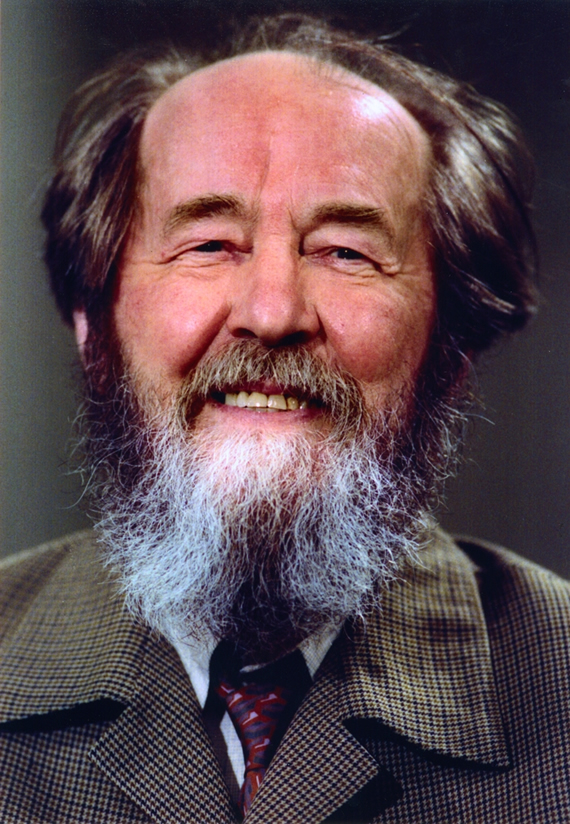
I love Russian Literature! So when I read a couple of weeks ago that Aleksandr Solzhenitsyn (see Biography) had died I was just a little sad. This guy was a true life hero. He, like many during Russia's infamous purges, was thrown into prison for defaming Stalin (he called him "the whiskered one"...I know shocking!). The guy spent 8 years in Russian labour camps or gulags. If that wasn't bad enough, he was diagnosed with cancer while there. During his exile following his release, Solzhenitsyn wrote and published his first book, One Day in the Life of Ivan Denisovich, his masterpiece. For it he received the Nobel Prize in 1970, an honor that was short lived. In 1974 he was formally stripped of his citizenship and forced to leave indefinitely. He would not be allowed to return to his beloved home until the collapse of Soviet Union in 1994.

We read the above novel for my Russian Lit class my last semester. It was the last book we read, a fitting end to what was a very dark set of novels. If you have read any Russian literature, you probably know what I mean. Not often does one expect to find happy ending. Reading Russian lit is tortuous, it really is. So why read it? Because, I would counter, life is tortuous. Sometimes our lives don't end happily. The hero in real life does not always make it out alive. Good does not always trump the bad. I wrote the following in my reading journal about the experience of reading Russian lit:

Russian literature does not ignore the dirty, cold, and horrible; instead it embraces them and acknowledges them as a legitimate and often ignored reality. In so doing, even it (and by that I mean all the dirty, cold, and horrible) becomes art, worthy of some form of aesthetic beauty and grandeur.
My particular reaction to One Day in the Life was much the same.

The thing that struck me more than anything else was the constant sense of fear that pervaded the novel. To live a life of fear is perhaps one of the most horrible things that I can imagine...

It seems so brutal to me, so demeaning, that the only choice one makes, and that the only living one does is surrounded by the fear of death. This fear makes a person obsessed with life, with just surviving...Such a life is demeaning because we lose what makes us human. We become our fear, and that alone is the only thing that survives.

Solzhenitsyn experienced the cold, dirty, and the horrible. He described what it was like to live with the constant fear of death surrounding every action and reaction, every decision, controlling every emotion. I didn't know what that feels like. But, in a small way, I do understand now what it must be like. And that is what makes this book, and others like it, semblances of a more experientially connected life.


"Remember, there is such a thing as good and evil."

"How can you expect a man who's warm to understand a man who's cold?"

"You can have power over people as long as you don't take everything away from them. But when you've robbed a man of everything, he's no longer in your power."


Friday, August 15, 2008

Okay I like Twilight...I confess!!!!!!


After reading my friends blog on Twilight, I decided I needed to come out of the elitist English major closet and confess that I also really enjoyed the Twilight series. After finishing the last book Breaking Dawn about a week ago, my love was once again renewed. Sure, there are a lot of things that I could complain of concerning the characters, but its hard to deny how entertaining and enthralling these books really are.
Oh and she posted a really cool quiz on her site. If interested follow
this link.
My results are as follows:

You are intelligent, outgoing & stylish. A true girly girl, you love shopping & makeovers. Although you are a generous friend, you can be coy, tricky & very persuasive in order to get your way. You are known to zone out occasionally during conversations, but your friends forgive you because you are understanding, supportive & know how to throw one heck of a party!

Look for my post reviewing Breaking Dawn...coming soon!


Wednesday, August 13, 2008

Wicked and da da dun....another interview

News: a report of a recent event; intelligence; information.

News Item #1:

I started reading Wicked. I know, I am about 2 years overdue. For over a year I've had various and sundry people ask me, tell me, beg me, and talk to me about IT. But they're many reasons why its taken me this long to begin.

First off, my first association with the franchise was NOT ideal. My freshman year of college I became acquainted with Wicked through the continual blasting of the token high notes of Broadway sopranos. To tell you the truth, I don't remember what they were singing about. I do remember my constant annoyance towards my roommate, who, from what I could tell, only listened to John Mayer (who I also loathe), the Beatles, and the Wicked soundtrack. I know, I thought it was a strange combo choice too.

To make matters worse, the first time I tried to begin the novel I was sick with food poisoning from bad Thai salmon. Let me tell you, reading anything is an experience when you're half delirious. When I was recovering from mono (and taking A LOT of Vicadin) I tried to read War of the Worlds. Yeah...need I say more?

Anyway, the point is, it didn't really work. The only thing I remember about the Wicked reading experience was the 'bawdy' show detailed at the beginning of the book. You know what I'm talking about...

News Item #2:

I have a job interview today. Its at the Singapore American School, the private, swanky, my family has more money than yours na na na, kind of school. Its for a job as a secretary (I know not the best I can do) but I'm guessing the job pays much more than entry-level publishing. We'll see.

News Item #3:

I have tentatively decided to try to get into Graduate school. Go me...

Friday, August 8, 2008

Brief Book Blurb

Life has been crazy this past week. In lieu of this and my own psychological need to convince myself I can at least finish ONE thing I started, here are VERY compact reviews of my last three July books.

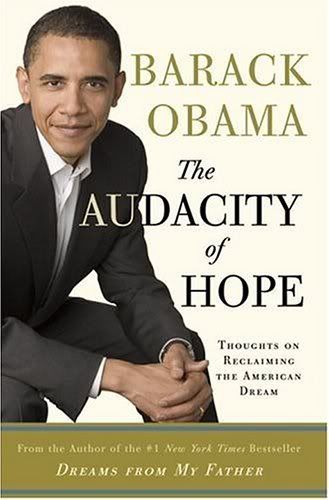
The Audacity of Hope by Barack Obama
4.5/5 stars
Written before he made his bid for presidential office (at least officially) this book was an uplifting prelude to Obama's official political philosophy ( just in case you have tuned out all news media during the past year and don't already know it). I found most of it to be good reading. His prose is critical without being offensive. He is both unapologetic and extremely honest about his own personal biases. He shows the reader a policy's flaws subjectively while objectively backing it up with facts, personal testimony, and experience. Check out "Opportunity" or "Race" if your undecided as to whether the book is worth reading. The writing will speak for itself.

If you are a fan of Barack I suggest reading the book. Am I being idealistic and naive to like his book as much as I like him? Maybe. Should you read the book if you are neither? Well, if you care anything about the future of this country if Obama is elected, it might be a good idea. Even if you are a Republican ass.

PS I am just kidding. Republicans are..., moral people.
PPS Disregard that last comment if you are not directly related to me. If not, then you probably are an ass.


Jesus Land: A Memoir by Julia Scheeres
4.5/5 stars


This book reminded me a lot of my other July book--Bastard out of Carolina. Both were extremely autobiographical and deal with broken families, abuse, and the child victims. Jesus Land was much less depressing though and in a way, it hit closer to home for me.

The book is about a deeply religious Midwestern family whose children include their white biological daughter Julia, and their two adopted black sons, David and Jerome. Obviously, issues of race come into play (the novel is based in the 70's). More important, however, is the author's understandable belief of the extreme hypocrisy intrinsic to the religious system her parents and community espouse, exemplified by the treatment of her father and mother towards their offspring and by the "Christian" reformatory " school she and her brother David are forced to attend.

The book is disturbing but honest. The "Jesus Land" of the author's childhood is turned into a kind of ironic hell, in a story that has become all too familiar in the modern 'Christian' community.

White Noise by Don DeLillo
3.5/5 stars

I would have given this book a higher rating because DeLillo is a BRILLIANT writer and his concept was very time appropriate (Postmodernist, dark, apocalyptic). But I have to admit, the novel was disappointing on many levels. It took until the airborne-toxic event (or Part 2) for me to even get into it. Sure, I kept reading because I hate giving up on books. But I did finish three separate books while I was still in the middle of this one.

Really though, I can see why it won the National Book Award. Beautiful prose, controversial topic, resonating, philosophic underpinnings blah blah blah. It wasn't as bad as I'm making it sound. But don't expect an easily accessible book because its not. Maybe the summer is making me lazy, brain-dead or both. But I had a hard time with it. If you want to read it by all means be my guest, but I would recommend it more as a book club selection or college required reading. Multiple insights are always a good way to go with text like these.
Side note: If you like technology this is probably not the book for you.

Friday, August 1, 2008

Review of July Books (Pt 2)

Dracula by Bram Stoker
3.5/5 stars

What you need to know:


  • Stoker's material was far from original; vampire lore has been around since the Middle Ages.


  • Count Dracula's historical basis was Vlad III, also know as the Prince of Wallachia or Vlad the Impaler.


  • The novel was preceded by John William Polidori's short story "The Vampyre" which conceptually began during a summer he spent with Lord Byron (Polidori was his physician), Percy and Mary Shelley, and Claire Clairmont (Byron's lover). During a three day rainstorm that forced the party indoors, each took turns telling the others a Gothic story. Mary Shelley's Frankenstein was also a product of this infamous gathering.

The bad:

  • The novel itself does not live up to its own hype. It begins slow, has A LOT of rising action, not much of a climax, and the ending was short, disappointing, and expected.
  • Johnathon Harker, one of the main characters, writes exactly like the solicitor he is meant to be, that is, quite dully.
  • The funniest character dies in the middle of the book.

  • Stoker uses the popular 19th century Mary/Eve dichotomy for his only two female characters. Shockingly, he decides to kill the "slut" and save the "angel".

The good:

  • Some parts are very funny.

  • The structure. Stoker's entire novel is composed of written dairies, letters, telegrams, and memorandums written by the different protagonists. I love shifting perspective, and Dracula is filled with it.

  • The sexual nuances between a vampire and his/her victim begin, in a lot of ways, with the relationship Stoker portrays between Lucy and Dracula and Harker and the three 'brides' of Dracula.


If you like vampires, Gothic tales, or even folklore, read it.


The Dead Travel Fast by Eric Nuzum
4/5 stars

A book that begins with an account of the author drinking his own blood is bound to be funny. The Dead Travel Fast is a smart, well researched, and well lived account of vampire lore, its cultural ramifications, and the days to day allusions to the undead we are only half aware of. During the author's journey he watches hundreds of vampire movies (his description of them is perhaps the funniest part in the book) travels to Transylvania, meets modern day, American vampires, and of course watches and loves every episode of Buffy The Vampire Slayer. His journey is extremely funny and over the top, and his discoveries and hypotheses as to why and how the world created and then obsessed over the vampire monster are revelatory and ring true.
I would recommend it to anyone who was ever been transfixed by the mystery of the undead. Or by a specific undead (ahem Edward, Angel, Spike...) Need I say more?

Here is an excerpt from the book. Enjoy...

"Watching my own blood drip down the bathroom mirror, there’s only one thought running through my head: In a lifetime of questionable decision making, this is not one of my finer moments...

The gore sprayed all over my bathroom was the result of the last of these undertakings: to drink blood. The whole blood-drinking thing, as you can imagine, posed several problems.

Most of these difficulties were rooted in the particulars. In my
book, to drink something means to take a mouthful of something and to swallow it—“tasting” or “sipping” wouldn’t be acceptable. This, of course, requires a sufficient quantity of blood.

Even though blood fetishists don’t advertise their gatherings in the Sunday paper, they aren’t particularly hard to find. However, anyone willing to let me drink their blood probably isn’t someone whose blood I should be drinking.

Then I got an idea: I could drink my own blood."

Monday, July 28, 2008

Review of July Books (Pt 1)

The Little Prince by Antoine de Saint-Exupéry
5/5 stars

This French children's book was a sweet tribute to the magic of imagination that so marks each of our life's beginnings and which the authors laments, is forgotten and put off for 'adult' things much too soon. The book is filled with all the best that is in children-- hope, mystery, simplicity, and faith, and it reminds us that we have much more to learn from children than they do from us.
Interestingly enough, the author chooses as his hero/philosopher a young, alien boy who is both a stranger to earth life and adulthood. Through him, we re-learn the basic truths we once knew as children; that truth lies in the heart and not the eyes, that individual knowledge and discovery comes only through truly knowing and living in the world around us, that imagination will always push us further than reason, and that love is definitively linked with responsibility, for to love is to care enough to be responsible for something or someone.
The tone of the story is often sad, but it is a sadness that is bittersweet. Written while his home country was occupied by Germany, it is no wonder the author sought to tell a story that makes you smile, laugh, cry, think, feel, love, question, and know. A story that hints at the beauty of life, while all the time reminding us of the truth of grief and of death. A story that is, much like life, at once bitter and sweet.


Bastard Out of Carolina by Dorothy Allison

4.5/5 stars


This book is one of the hardest books I've ever read. Let me explain. The book centers on Bone, a girl of illegitimate birth who is officially branded by her birth certificate a 'bastard' child. As she grows up, readers are introduced to an array of family members, all of which are the typical Southern degenerates; there are Bone's alcoholic uncles who are in and out of prison, her cousins who steal cars and break into stores, and her grandma who chews tobacco, is without teeth, and is a blasphemous heathen. All of whom are described in such a funny and loving way as to render their obvious flaws obsolete next to their more redeeming qualities. Through their displays of passionate filial loyalty, Bone's family protects and provides unselfishly for each other, oftentimes to their own physical detriment.
What makes the book so hard to read is that much of the book is filled with Bone's struggles against her stepfather, who abuses her physically, emotionally, and sexually. Even tougher, are the questions the authors poses to readers throughout the family saga: What defines a mother's love? Is love an unconditional emotional response? Which is more necessary-filial love or romantic love? In the end, does love, or at least the things we do for love, engender more evil than good?
The book is poignantly beautiful in a way that is darkly haunting (I'll never forget the ending). It tells of love and family, but in a way that renders both disturbing. It tells of the best and worst in us all, and it tells it uncensored, uninhibited, and unapologetically. Read it. If only to understand the dark, and in that dark, to see brief shades of light.